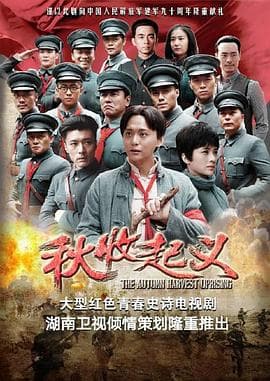
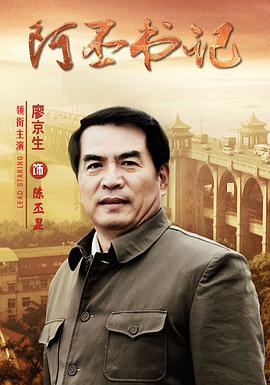
In 1927, the April 12 and July 15 counter-revolutionary coups occurred one after another. In order to save the revolution, the Central Committee of the Communist Party of China held the "August 7th Conference" and decided to appoint Mao Zedong (played by Hou Jingjian) to lead the Autumn Harvest Armed Rebellion in the Hunan-Hubei-Jiangxi border area. On September 9, Mao Zedong announced an uprising and personally led the Third Regiment of the First Division of the Workers' and Peasants' Revolutionary Army to victory in the first battle, successfully occupying Baisha Town, Dongmen City and other places. But soon, Qiu Guoxuan's fourth regiment, which had been temporarily incorporated, rebelled. Wang Xinya's second regiment was arrogant and underestimated the enemy and was flanked. The third regiment also suffered serious setbacks because the enemy was strong and we were weak. Mao Zedong immediately changed his plan to attack Changsha and decided to lead his troops to the Luoxiao Mountains where the enemy was weak. Afterwards, the Autumn Harvest Uprising troops experienced the "Three Bay Reorganization" and established the highest principle of "the party's absolute leadership over the military." On April 28, 1928, the Autumn Harvest Uprising troops led by Mao Zedong and the Shonan Uprising troops led by Zhu De successfully joined forces in Jinggangshan, forming the largest and most powerful revolutionary armed force under the leadership of the Party. This marked the true birth of the predecessor of the Chinese People's Liberation Army - a Chinese workers' and peasants' Red Army that was absolutely loyal to the Party and served the people wholeheartedly.
Boost tomorrow's productivity tonight. Tongbao VPN delivers fast, reliable access to global AI tools and office platforms. Sign up for 200MB free.